
The 2027 Hotel Budget: Growth Is the Headline. The Details Are the Strategy
The 2027 hotel outlook is positive, but growth won't be evenly distributed. National forecasts provide a useful benchmark, while individual hotel performance will depend much more on local demand, competitive supply, segment mix, compression periods and the property's ability to capture profitable market share. This article looks at the major commercial themes revenue teams should consider as they build their 2027 budgets and explains why the annual g
Hotel budget season has a way of making a complicated commercial environment look deceptively simple. Take last year's performance, layer in the market forecast, add a reasonable growth assumption, and eventually arrive at a number everyone can live with.
For 2027, that approach misses much of what is happening underneath the national outlook. Most major forecasts currently converge around roughly 2.1% RevPAR growth for 2027. Demand is expected to remain positive, ADR should continue growing modestly, business travel is improving, international visitation is expected to recover further, and national hotel supply remains relatively restrained. It's a constructive outlook, but not an especially dramatic one.
The more interesting story is how unevenly that growth is likely to show up. The research points to significant differences by market, segment, day of week and individual demand period. For revenue teams, that means the national forecast is useful as a benchmark, but considerably less useful as the methodology for building an individual hotel's budget.
The National Forecast Is the Starting Point
One of the stronger opportunities heading into 2027 is the continued recovery of weekday demand. Business transient has moved beyond being something we're waiting to return and has become a credible source of growth, particularly for urban, corporate and upper-upscale hotels. Group demand has improved as well, although the way that business materializes has changed. Shorter lead times mean a hotel can look considerably underbooked at 60 days and still finish strongly, making traditional pace comparisons less reliable than they once were.
International travel provides another potential source of incremental demand. Current forecasts call for U.S. international visitation to increase from roughly 70.5 million visitors in 2026 to 74.1 million in 2027. Canada and Mexico account for almost half of that projected increase, while several Asian source markets are expected to post some of the strongest percentage growth. For hotels with meaningful international exposure, that can influence more than occupancy. Longer stays, premium room demand and shoulder-night contribution can all improve as the mix changes.
Leisure is more complicated. The consumer has become increasingly divided, with affluent travelers retaining greater ability to spend on travel and premium experiences while more price-sensitive households remain exposed to the total cost of the trip. That makes a broad assumption that "leisure grows 3%" increasingly difficult to defend. The better forecast separates the demand the hotel is actually positioned to capture from the demand that simply exists somewhere in the market.
Taken together, the demand outlook is positive. The important distinction is that positive demand doesn't automatically produce positive results in equal measure for every hotel.
Pricing Power Will Have to Be Earned
ADR is where the 2027 budget requires more discipline. National forecasts generally put ADR growth somewhere in the mid-1% range. That's positive, but it doesn't support simply increasing BAR across the board and calling it a rate strategy. The research instead points toward a year when pricing power is likely to become concentrated around identifiable periods of compression.
That makes the calendar considerably more important. A major convention, overlapping group and transient demand, a concert weekend, premium leisure period or a room category that becomes scarce can create legitimate opportunities to push rates. The opportunity is to identify those periods early enough to protect inventory and price into the demand rather than discovering the compression after the hotel is already full.
The reverse matters just as much. In markets with significant new supply, price-sensitive demand or limited compression, aggressive ADR assumptions become harder to support. The same hotel may have periods where rate can move materially and others where protecting occupancy and contribution matters more. Treating both periods the same because they happen to sit inside the same annual budget is where a reasonable forecast can start drifting away from the actual commercial environment. For 2027, pricing is less about inflation and more about precision.
The 2026 Comparison Needs Context
There is another complication sitting inside next year's growth percentages: 2026 wasn't a normal comparison year. The FIFA World Cup generated approximately $680 million in incremental hotel room revenue across the eleven U.S. host markets, with much of that impact coming through unusually strong pricing. America250 and other major events created additional pockets of exceptional performance.
Those results don't simply roll forward. A hotel can therefore experience healthy underlying demand in 2027 while still reporting negative year-over-year ADR or RevPAR during periods that are compared against extraordinary 2026 performance. Los Angeles is a good example. Super Bowl LXI creates significant February opportunity, while the disappearance of World Cup demand produces a very different summer comparison. One annual growth assumption can't accurately describe both conditions.
For hotels exposed to these events, normalizing the 2026 base becomes an important part of the budget process. Reported 2026 remains the financial comparison, but normalized 2026 provides a much better view of the underlying demand the hotel is actually trying to grow. Without that distinction, a difficult comparison can easily be mistaken for deteriorating demand.
Supply Is a Local Problem
Nationally, the hotel development picture remains relatively favorable. Locally, the story can look very different. Dallas-Fort Worth, Atlanta, Nashville, Phoenix and Austin carry some of the largest development pipelines in the country. For hotels operating in those markets, incremental demand has to absorb additional rooms before it translates into occupancy growth or greater pricing power. A national supply forecast isn't particularly useful when several thousand rooms are being added within the geography that actually competes for your guests.
New construction isn't the only consideration. Conversions, renovations and repositionings can materially change a competitive set without increasing the physical room count. An existing hotel can renovate, change flags and move into a different competitive tier, changing the pricing environment almost overnight.
For property-level budgeting, the more useful exercise is understanding net competitive supply: what's opening, what's closing, what's converting, what's being renovated and which properties will realistically compete for the same demand in 2027. That local view becomes especially important when the budget assumes market-share growth.
Growth Should Be Tested Against the Market
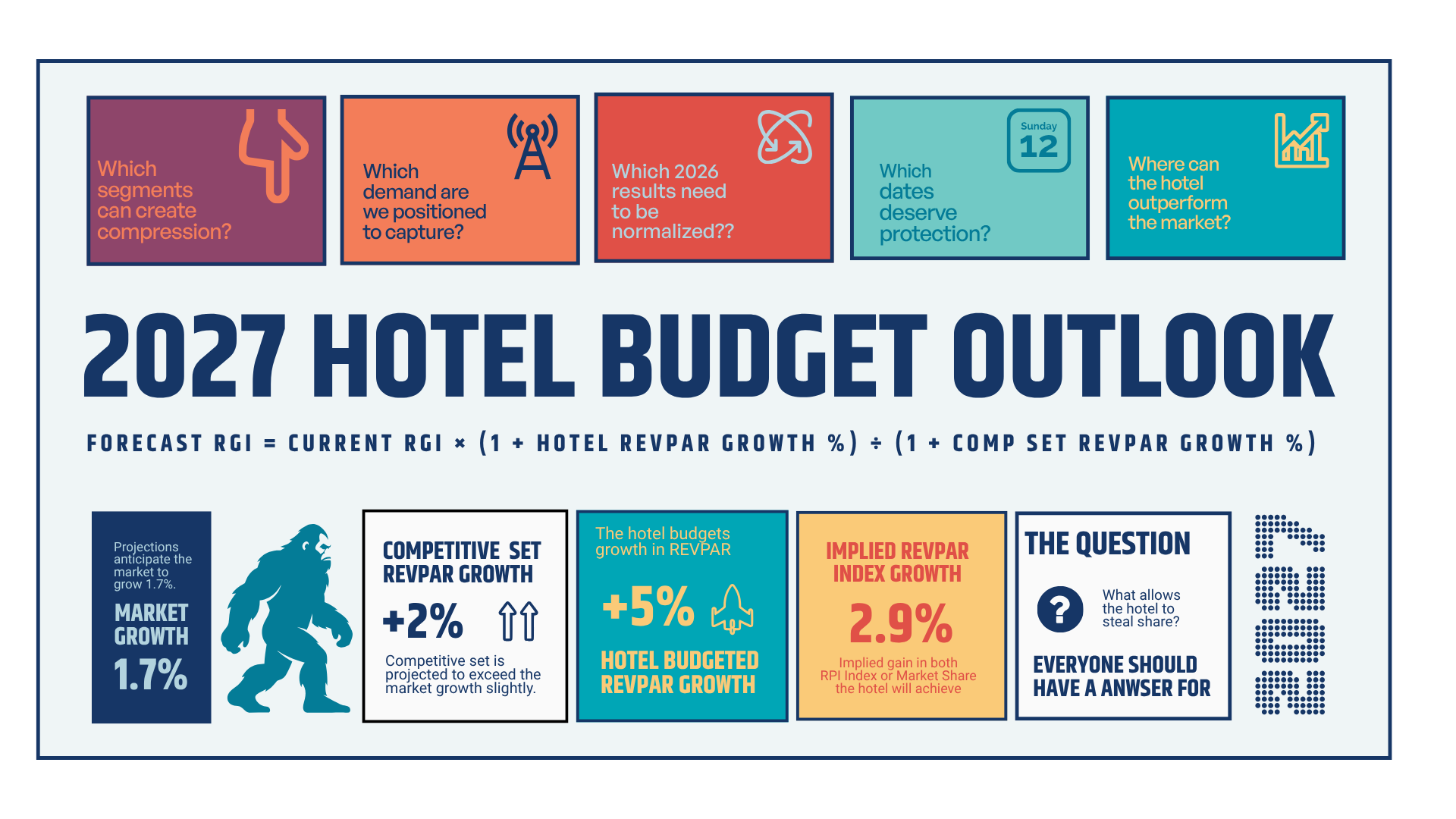
A hotel budgeting 5% RevPAR growth while its competitive set is expected to grow 2% isn't simply forecasting 5% growth. It's forecasting that the property will outperform the market and gain share.
That may be completely reasonable. A renovation, stronger corporate production, better group base, improved pricing, new demand generator or competitor closure can all support meaningful share growth. The important part is connecting the improvement to something the hotel can actually explain and execute.
This is where the RevPAR Index becomes particularly useful as a budget validation tool. Forecasting MPI, ARI and RGI alongside the financial budget exposes assumptions that are easy to miss when a hotel is evaluated only against its own prior-year performance. A 4% RevPAR increase looks healthy on its own. If the competitive set is expected to grow 6%, the hotel is budgeting share loss. If the market grows 1%, the same 4% forecast implies meaningful share gain. The growth rate hasn't changed, but the commercial implication has.
This also creates a more useful way to approach aggressive ownership targets. When the growth expectation itself isn't negotiable, the conversation can move toward the inputs required to produce it. If the hotel needs to materially outperform the market, the strategy may require additional sales resources, greater marketing investment, a different channel strategy, stronger programming, improved conversion or changes to the product itself. The target can stay on the table. The resources and strategy required to reach it need to be there with it.
Build the Budget From the Demand Up
The broader lesson from the 2027 research is that the annual growth percentage should be the result of the forecast rather than the starting point. Begin with the demand the hotel is reasonably positioned to capture. Layer in the competitive supply environment, segment and channel mix, business and group recovery, international exposure and the events that will change demand throughout the year. Normalize the unusual 2026 comparison periods, then identify where those demand streams overlap and create genuine compression.
From there, the rate strategy becomes much clearer. So does the occupancy strategy. And just as importantly, the hotel can begin evaluating the quality of the business being used to produce that growth. Acquisition cost, cancellation behavior, length of stay and displacement all affect whether another occupied room actually improves the hotel's commercial position.
National RevPAR may ultimately grow 1.8%, 2.1% or 2.4%. For an individual hotel, getting that decimal exactly right matters considerably less than understanding where to push, where to protect, where the comparison is misleading and where the hotel has a credible opportunity to outperform. That's where the 2027 budget starts becoming a strategy rather than a spreadsheet.
Go Deeper: The 2027 Hotel Budget Outlook
While this overview offers an initial summary, the comprehensive report—"2027 Hotel Budget Outlook: A Commercial Playbook for Revenue Leaders & Friends"—provides an in-depth analysis. Inside, you will find key insights covering national market forecasts, demand and ADR projections, local supply pressures, and international market recovery trends. It also addresses targeted segment strategies, evolving booking behavior, conditions across the Top 30 U.S. markets, event-driven calendar risks, RevPAR Index validation techniques, scenario-based budget modeling, and core performance indicators to track throughout 2027. We crafted this resource specifically to support our hotel community colleagues in naviagting toward a successful budget season.
It also includes the supporting research and source material behind the analysis, so revenue teams can use the report as a starting point for building and challenging their own assumptions rather than simply adopting ours.
Get the full 2027 Hotel Budget Outlook →